
About
A Sahel research project.
Principal
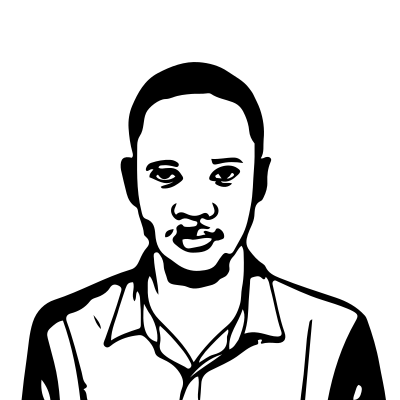
The principal carries responsibility for the direction and integrity of the lab. Mansir Muhammed serves as its founding principal. Future holders of the role are appointed by the board of trustees.
Mission
The Mansir Muhammed Research Lab is a Sahel intelligence project. Its work is to build the empirical record of West Africa and the Sahel from primary sources, and to produce analysis, tools, and narrative on top of that record. This geography has been hard to read for a long time, and the lab is an attempt to change that.
The research draws from archival extraction, structured data production, primary data, and software development. The project's range touches the science and art of quantifying the Sahel problem.
The archive is open to everyone. Researchers, journalists, and the institutions that rely on it help sustain the work.
Collaboration
Collaborators engage with the work directly — asking questions, testing tools, reviewing findings, and contributing to active research projects. Access to the lab is free and open.
Peer review is built into the research process. Experts are invited to review specific answers and computations, verify methodology, and submit formal verdicts. This is essentially commissioned review work: an expert is given a focused piece of research and asked to assess it on its merits. Honoraria are available for work that warrants it.
Fellowships connect domain experts with active projects over a sustained period. Sponsored fellowships are available for research that benefits from long-term specialist involvement.
Anyone can collaborate — researchers, practitioners, developers, students, or curious observers. Reach out through a project page or the Support section.
Organisation
The lab operates as Mansir Muhammed Research Lab Ltd/GTE, a company limited by guarantee. This structure reflects the lab's commitment to operating as a public-interest entity: profits cannot be distributed to members, and any surplus is reinvested into research, infrastructure, and collaboration.
Funding comes from patrons, grants, and institutional partnerships. Allocation of funding is documented publicly on the Support page.
Team5
"If I have seen further than others, it is by standing upon the shoulders of giants."
— Isaac Newton

Collaborators
The principal, fellows, sponsors, and collaborators who make the work possible.
AI in the workflow
Most research problems that matter involve data that is messy, large, or arrives faster than any single person can process. Several models sit inside the workflow — not to answer the research questions, but to handle the parts that would otherwise slow things down: finding candidate sources, drafting a first synthesis from a pile of log entries, flagging inconsistencies across a dataset, generating code for a new analysis.
Every output that comes out of that goes through editorial review before it becomes part of a finding. The model produces a draft; the researcher decides what the draft means and whether any of it is publishable. That distinction matters enough to document here.
The full stack — which models, what each one is used for, and how they sit inside the research process — is on the AI Layer page.
Privacy
The lab collects only the data needed to operate: account credentials, collaboration activity, and optional profile information you choose to provide. No behavioural tracking. No third-party advertising cookies. No selling of data.
Public profiles and patron listings are opt-in. All collaboration activity — reviews, project contributions, feedback — is handled with discretion and shared publicly only where you have explicitly chosen to make it visible.
For questions about your data, contact the principal through the Support page.