The Sahel Table is a weekly data publication that tracks major regional developments in environment, security, economics, and politics across the Sahel and West Africa. Each issue transforms the week's events into structured data for analysis, comparison, and long-term tracking.
Executive Summary
This first issue covers events recorded during the seven days leading to 20 June 2026.
This week's dataset is dominated by security and economic developments. Armed attacks in Niger, worsening humanitarian conditions across the Central Sahel, and mounting food insecurity continue to shape the regional security landscape. Meanwhile, persistent currency pressures in Nigeria and growing fiscal challenges in Senegal highlight the economic strains facing some of the region's largest economies.
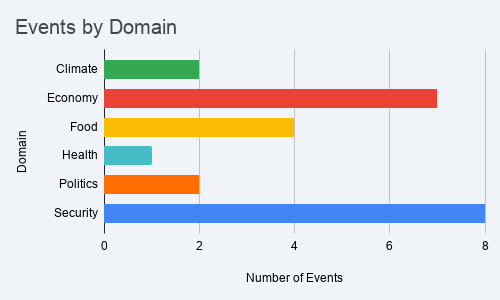
Together, security and economy account for the majority of recorded events this week, illustrating how conflict and economic instability continue to define the region's immediate challenges.
Key Takeaways
Escalating Security and Humanitarian Crisis
The security situation across the Sahel remains highly volatile, with armed groups continuing to expand operations and humanitarian needs increasing.
-
Niger: A major attack by JNIM targeted the Niamey airport and nearby military facilities, reportedly killing approximately 35 people, including 11 soldiers and 22 attackers.
-
Regional displacement: Across Burkina Faso, Mali, and western Niger, an estimated 2.8 million people remain internally displaced, while more than 2,600 conflict-related deaths have been recorded.
-
Humanitarian funding: The Central Sahel Humanitarian Response Plan currently requires US$658.5 million to meet urgent humanitarian needs.
Food Security Continues to Deteriorate
Food insecurity remains one of the region's most pressing challenges and is expected to worsen during the June–August lean season.
-
Approximately 41.8 million people currently face acute food insecurity.
-
That number is projected to rise to 52.8 million people over the coming months.
-
In Borno State, Nigeria, more than 15,000 people are assessed to be at risk of IPC Phase 5 (Catastrophe)—the highest level of food insecurity.
Economic Pressures Persist
Major economies across West Africa continue to face fiscal and monetary challenges.
Nigeria
-
The Naira continues to weaken, trading around ₦1,400 per US dollar on the parallel market.
-
Inflation is projected to remain around 20%, further reducing household purchasing power.
Senegal
-
Rising global oil prices could increase Senegal's fuel subsidy bill by approximately 1.15 trillion CFA francs (about US$2 billion).
-
Economic growth is expected to slow to 2.5%, down from 6.7% recorded the previous year.
Data Snapshot
The following visualisations summarise this week's structured dataset.
Distribution of Events by Domain
Security and economic developments dominate this week's dataset, together accounting for more than 60% of all recorded events. Humanitarian, governance, environmental, and political developments make up the remainder of reported incidents.
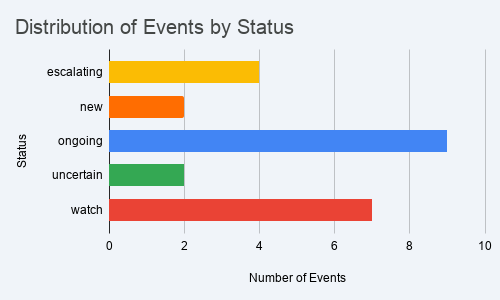
Distribution of Events by Status
Most recorded events are classified as Ongoing or Watch, reflecting persistent conditions rather than isolated incidents. A notable share of security-related events are categorised as Escalating, highlighting areas where risks continue to increase and require close monitoring.